 Add to Chrome
 Add to Firefox
 Add to Edge
Automatic Attenuation Control for Mitigating Photon-Counting Saturation in SPAD-based Optical Wireless Communications
May 27, 2026
Single-photon avalanche diodes (SPADs) have emerged as a promising candidate for optical wireless communication (OWC) owing to their ultra-high sensitivity and singlephoton detection capability. However, under strong background radiation or high signal power, SPAD-based receivers suffer from photon-counting saturation, which severely degrades communication performance. To address this challenge, this paper introduces an automatic attenuation control (AAC) technique that dynamically optimizes the incident optical intensity to mitigate saturation effects. We develop a comprehensive analytical model for the SPAD-based OWC system, incorporating the influence of dead time and the lack of photon-number resolution. Based on this model, a convex optimization-based AAC algorithm is proposed to maximize the achievable rate in real time. Furthermore, a low-complexity AAC algorithm is devised using a closed-form trigger probability criterion, reducing computational complexity by two orders of magnitude. Numerical results demonstrate that the proposed AAC technique significantly improves both the achievable rate and symbol error rate across a wide range of background conditions, providing an efficient solution to enhance the dynamic range of photon-counting receivers.

Unified Analytical Framework for SPAD Array Receivers with Dead-Time-Induced Blocking Loss and Inter-Symbol Interference in PAM-OWC Systems
May 27, 2026Optical wireless communication (OWC) leveraging single-photon avalanche diode (SPAD) arrays offers exceptional sensitivity for photon-starving links. However, the inherent dead time of SPADs critically limits achievable data rates by introducing non-linear photon-counting distortions: blocking loss within a symbol duration and inter-symbol interference (ISI) across durations. This paper proposes a unified analytical framework capturing both distortions across all operational speed regimes for pulse-amplitude modulation (PAM), by establishing comprehensive statistical models for SPAD array receivers. For low and medium-speed systems (symbol duration longer than dead time), we derive exact closed-form expressions for the photon counts probability distribution using renewal theory, explicitly incorporating blocking loss and ISI. For high-speed systems (symbol duration shorter than dead time), we develop a Markov chain model characterizing the steady-state operational states and integrate it with trigger probability to obtain the exact binomial photon counts distribution. Furthermore, we propose low-complexity, near-optimal threshold detection schemes based on these models. This work provides essential theoretical tools for designing and optimizing high-performance SPAD-based OWC systems employing PAM.
Performance Analysis of Photon-Limited Free-Space Optical Communications with Practical Photon-Counting Receivers
Aug 24, 2024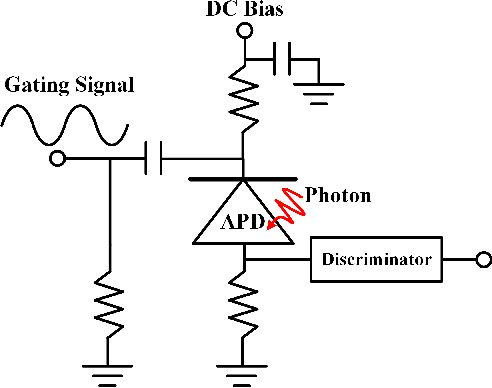
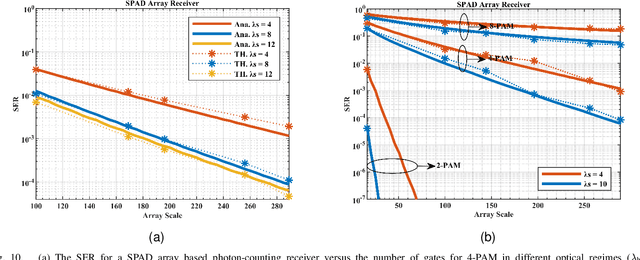
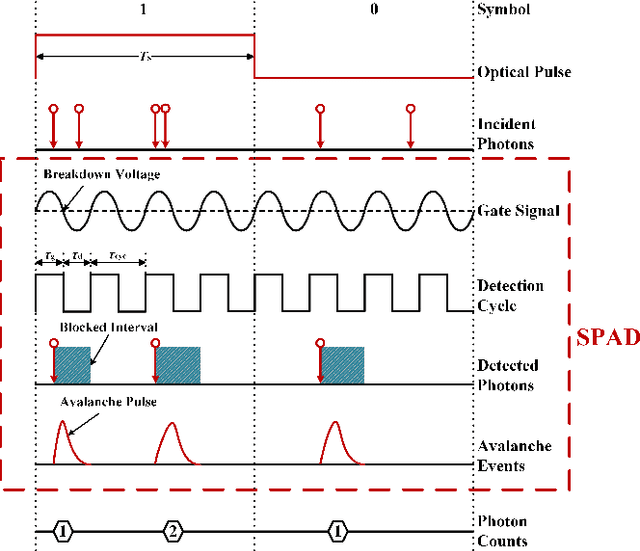
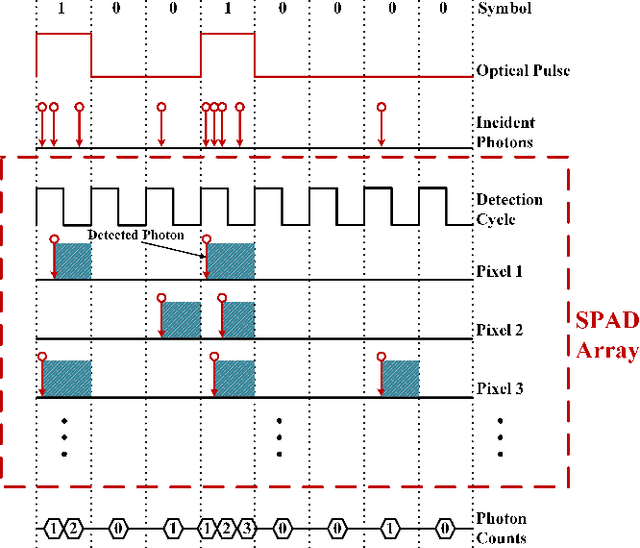
The non-perfect factors of practical photon-counting receiver are recognized as a significant challenge for long-distance photon-limited free-space optical (FSO) communication systems. This paper presents a comprehensive analytical framework for modeling the statistical properties of time-gated single-photon avalanche diode (TG-SPAD) based photon-counting receivers in presence of dead time, non-photon-number-resolving and afterpulsing effect. Drawing upon the non-Markovian characteristic of afterpulsing effect, we formulate a closed-form approximation for the probability mass function (PMF) of photon counts, when high-order pulse amplitude modulation (PAM) is used. Unlike the photon counts from a perfect photon-counting receiver, which adhere to a Poisson arrival process, the photon counts from a practical TG-SPAD based receiver are instead approximated by a binomial distribution. Additionally, by employing the maximum likelihood (ML) criterion, we derive a refined closed-form formula for determining the threshold in high-order PAM, thereby facilitating the development of an analytical model for the symbol error rate (SER). Utilizing this analytical SER model, the system performance is investigated. The numerical results underscore the crucial need to suppress background radiation below the tolerated threshold and to maintain a sufficient number of gates in order to achieve a target SER.
A Novel Signal Detection Method for Photon-Counting Communications with Nonlinear Distortion Effects
Aug 20, 2024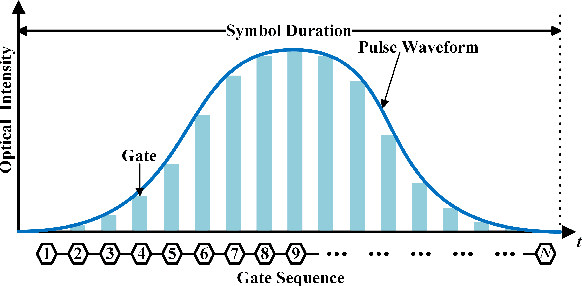
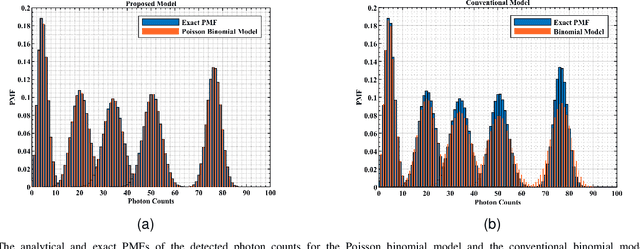
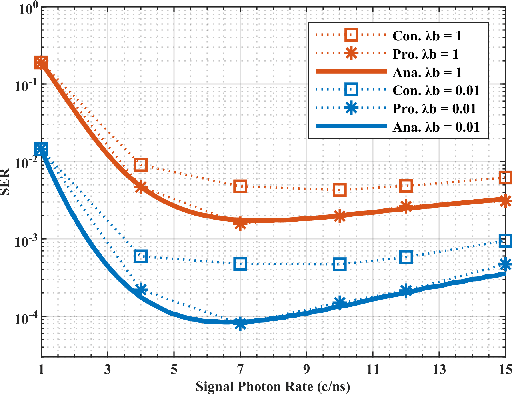
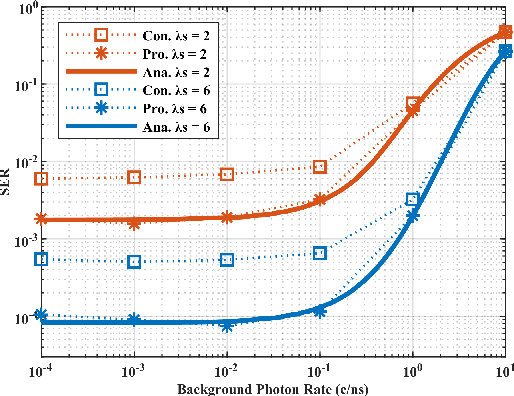
This paper proposes a method for estimating and detecting optical signals in practical photon-counting receivers. There are two important aspects of non-perfect photon-counting receivers, namely, (i) dead time which results in blocking loss, and (ii) non-photon-number-resolving, which leads to counting loss during the gate-ON interval. These factors introduce nonlinear distortion to the detected photon counts. The detected photon counts depend not only on the optical intensity but also on the signal waveform, and obey a Poisson binomial process. Using the discrete Fourier transform characteristic function (DFT-CF) method, we derive the probability mass function (PMF) of the detected photon counts. Furthermore, unlike conventional methods that assume an ideal rectangle wave, we propose a novel signal estimation and decision method applicable to arbitrary waveform. We demonstrate that the proposed method achieves superior error performance compared to conventional methods. The proposed algorithm has the potential to become an essential signal processing tool for photon-counting receivers.